
Blog
The INTELLIGENCE Behind the INFRASTRUCTURE - How Site Technology Is Putting AI to Work

We've spent 35 years building the systems that keep businesses running — power grids, data centers, security networks, airport infrastructure. We know what it means to operate in environments where there is no margin for error, no room for downtime, and no tolerance for threats going undetected.
That experience is precisely why we took our time before putting the word "AI" on anything we do. We didn't want to follow a trend. We wanted to use it where it actually changes outcomes.
We're ready to talk about what that looks like.
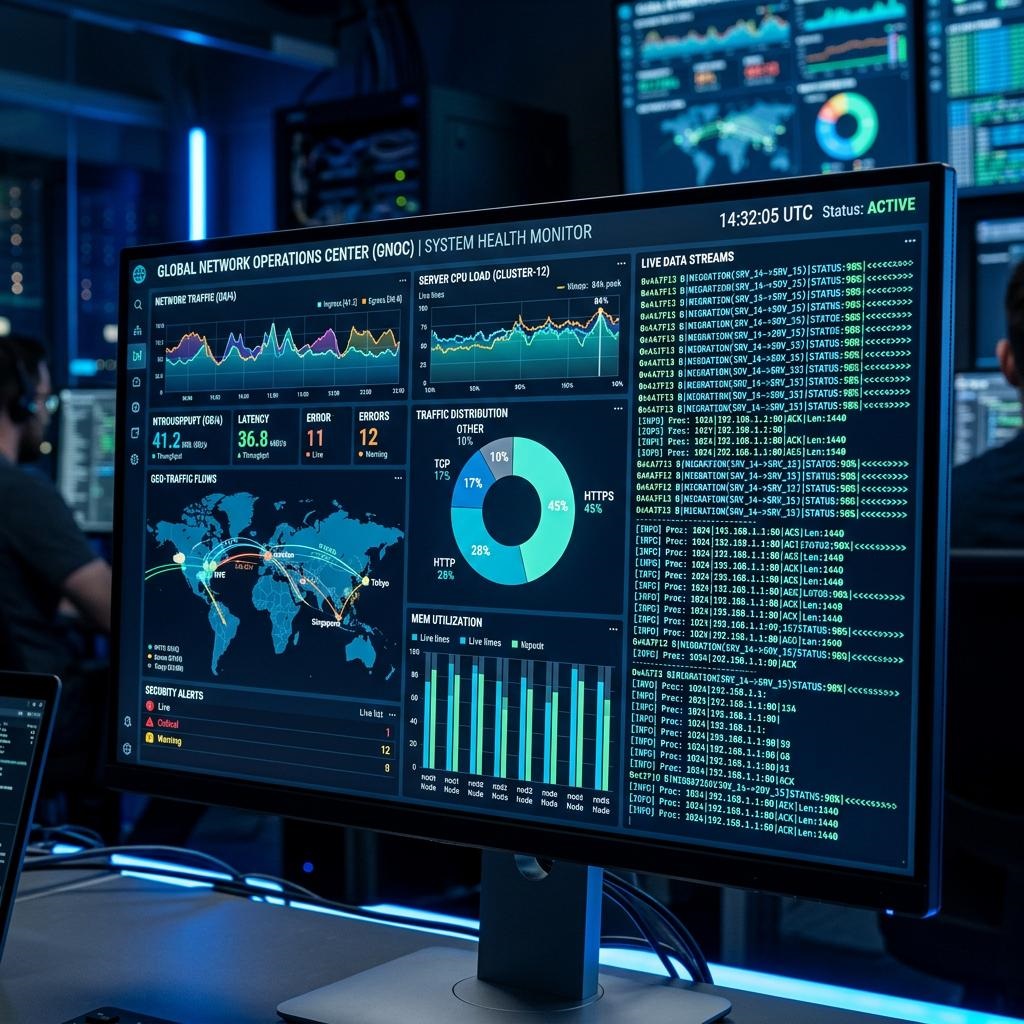
From Reactive to Predictive: The Real Value of AI in Infrastructure
Traditional IT infrastructure management is largely reactive. Something fails, an alert fires, a team responds. In mission-critical environments — a data center running financial operations, an airport network managing passenger security, a government facility where systems never sleep — that model isn't good enough.
AI changes the equation entirely.
Through AI-native platforms integrated into our network operations, we now monitor traffic patterns, device behavior, and system performance in real time — not to describe what happened, but to anticipate what's about to. Predictive maintenance algorithms flag anomalies before they become failures. Automated configuration and self-healing remediation reduce the window between detection and resolution from hours to seconds.
The result: fewer incidents, faster recovery, and engineering teams freed from routine firefighting to focus on strategic work.

Security That Thinks Faster Than the Threat
Cybersecurity is where AI delivers its most immediate and measurable impact — and it's one of the areas where we've seen the fastest evolution in both the threat landscape and the tools available to combat it.
The threats our clients face today are not the threats of five years ago. Attacks are more sophisticated, more targeted, and in many cases, partially automated themselves. Matching that with human-only response capacity creates an inherent gap.
Our AI-Powered Security approach closes that gap. By deploying machine learning models that continuously analyze endpoint behavior and network traffic, we detect anomalies that would never trigger a conventional rule-based system. Adaptive security policies update dynamically based on live risk analysis. When a threat is identified, autonomous response mechanisms act — not after a human approves a ticket, but in the moment.
For clients managing sensitive infrastructure across the GCC, this is no longer a future capability. It's a present-day requirement.
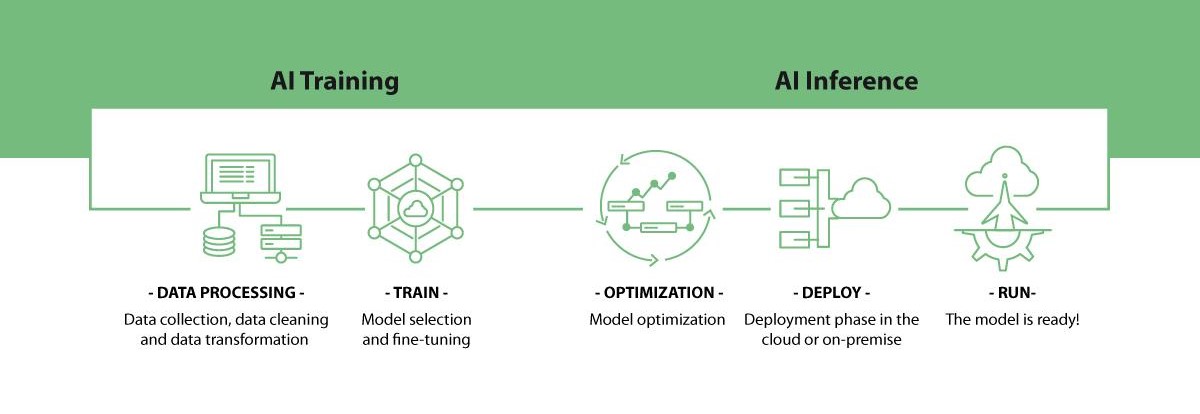
Custom Intelligence for Your Operations
Not every business problem needs a generic solution. Some of the most impactful AI work we do is the most specific: a Custom AI/ML model built around a client's actual data, their actual workflows, and their actual goals.
We develop these models to solve the kinds of problems that have always existed but could never be addressed at scale — business process bottlenecks that weren't visible until you looked at the patterns across thousands of transactions, predictive analytics that connect operational signals to business outcomes, automation workflows that eliminate manual steps no one ever had time to redesign.
The question we ask clients isn't "do you want AI?" It's: where is your team spending time on something a model could handle better, faster, or more consistently? The answer is almost always somewhere meaningful.

Why This Matters Now
Across the UAE, Saudi Arabia, Qatar, and the broader region, digital transformation has accelerated significantly. Governments are investing in smart infrastructure. Enterprises are migrating to hybrid cloud environments. Data center capacity is expanding rapidly to meet demand. Each of these shifts creates new complexity — and new vulnerability — that AI is uniquely positioned to manage.
Site Technology has always positioned itself at the intersection of technology and critical infrastructure. AI-driven solutions are a natural extension of that. We're not applying AI as a feature. We're integrating it as a foundational layer — into how networks are managed, how threats are detected, how systems heal, and how decisions get made.
The infrastructure we build has always been empowered by INNOVATION. Now, it's empowered by INTELLIGENCE